Google Forms vs Joy
Short answer: price will not decide this one — both can be used without paying. Choose Google Forms if anyone who needs to collect answers at zero cost and does not care how the invitation looks. Choose Joy if couples who want a free, well-designed website, app and RSVP system with unlimited guests and optional paid stationery.
If neither answer fits, Dawat does the same job free at any guest count: 53 card designs, unlimited guests, per-guest personal links and RSVP tracking, with no per-recipient charge.
Google Forms and Joy are built for different jobs, so the comparison is less about features and more about which job you are actually doing.
Google Forms and Joy pricing checked 2026-09-16 against their own published pages. Sources · Method
On this page
Side by side
Free Google survey and form builder that collects responses into Sheets, available with any Google account and bundled in Google Workspace. Free wedding website, app, registry and RSVP platform with optional paid domains, SMS messaging and premium digital or printed cards. Dawat is shown as a third column for the part these two share with it: getting the invitation to people and getting an answer back. It does not print, so on the physical card it is not a substitute.
| Google Forms | Joy | Dawat | |
|---|---|---|---|
| Pricing model | Free | Free tier, paid upgrades | Free |
| What the free tier gives you | The whole product: unlimited forms, responses stored in Google Sheets, no ads, no branding fee. | Website, planning dashboard, registry, mobile app, unlimited guests, online RSVP, and hundreds of free digital invite designs. | Everything except Signature: all card designs, party pages, unlimited guests, sends, RSVP tracking and analytics. |
| Cost for 100 guests | Free | Free | Free |
| Cost for 250 guests | Free | Free | Free |
| Charges per recipient | No | Partial | No |
| Guests need an account | Partial | No | No |
| Ads shown to guests | No | Not published | No |
"Not published" means no vendor documentation could be found either way, not that the feature is missing. How this grid is built →
Where they actually differ
Both give you sending invitations without paying, so those are not the thing to decide on.
- Per-guest fees. Joy does this in some cases; Google Forms does not. If no per-recipient charge matters to you, that is a point for Google Forms.
- Unlimited guests. Joy supports an uncapped guest list. Google Forms does not publish whether it does, so treat it as unavailable until you have confirmed it.
- RSVP tracking. Joy includes tracking who has replied outright; on Google Forms it is limited or tied to a paid tier.
- Custom RSVP questions. Google Forms supports asking your own questions. Joy does not publish whether it does, so treat it as unavailable until you have confirmed it.
- Email delivery. Joy includes sending by email outright; on Google Forms it is limited or tied to a paid tier.
- Printed cards. Joy supports ordering printed stationery; Google Forms does not.
- Guest account required. Google Forms does this in some cases; Joy does not. If letting guests reply without an account matters to you, that is a point for Joy.
- Ads shown to guests. Google Forms does not do this. Joy does not publish whether it does, so it is worth checking before you send.
When Google Forms is the better choice
Anyone who needs to collect answers at zero cost and does not care how the invitation looks.
- Completely free with no response charge, no ads and no upsell
- Unlimited custom questions with logic, sections and validation
- Responses flow straight into Google Sheets for sorting and analysis
- Familiar to almost every respondent; nothing to learn or install
Where it costs you:
- No invitation design, envelope animation or card rendering of any kind
- No guest list: it collects responses, not RSVP status per invited person
- Sign-in is forced for file upload questions, verified email collection, response editing or one-response limits
- No SMS or WhatsApp delivery and no per-guest personal links
- Bare, uniform form styling that does not read as a celebration invitation
When Joy is the better choice
Couples who want a free, well-designed website, app and RSVP system with unlimited guests and optional paid stationery.
- Genuinely free core: website, registry, RSVP, mobile app and unlimited guests
- Hundreds of free digital invitation and save the date designs sent by email
- Guests do not need an account; signup is offered only after RSVP
- Multi-language support including English, German, Spanish, French, Italian and Japanese
- Paper invitations from $1.39 each with free recipient and return address printing
Where it costs you:
- Premium digital cards carry a 50-card minimum order and are sold in fixed bundles
- SMS delivery of premium cards is a paid add-on, US and Canada numbers only
- Messaging Plus, which unlocks text blasts and RSVP reminders, is a separate purchase
- Prices for Messaging Plus and premium digital cards are not published on help pages
- Custom domain costs extra, quoted at roughly $19.99 per year
What each one costs, in dollars
Neither Google Forms nor Joy bills by guest count, which puts them among the 26 platforms in this dataset that do not.
Published prices, converted into what you would actually pay for a real guest list. Credits, coins and per-card pricing are translated into dollars because that is the number you are deciding with.
| Google Forms | Joy | Dawat | |
|---|---|---|---|
| Pricing model | Free | Free tier, paid upgrades | Free |
| 100 guests | Free | Free | Free |
| 250 guests | Free | Free | Free |
| How that is worked out | Forms is included at no cost with any Google account and Google publishes no per-response charge or response cap for it. | Free basic digital cards and RSVP carry no per-guest fee; premium cards and SMS bundles are priced only at checkout. | Dawat has no per-guest or per-send charge, so the guest count does not change the price. |
As of September 2026: Free with a personal Google account. Bundled in Google Workspace at $7 (Starter), $14 (Standard) and $22 (Plus) per user per month, with Enterprise quoted by sales. Joy states the core product is $0/month with unlimited guests; paid extras are a custom domain (about $19.99/year), Messaging Plus SMS, premium digital cards (50-card minimum) and paper from $1.39 each.
The third option: something that feels like an invitation
Neither Google Forms nor Joy is trying to make the moment of opening feel like anything. They collect the answer. For a birthday drinks thread that is exactly right; for a wedding, a nikkah or a milestone, the invitation is part of the event.
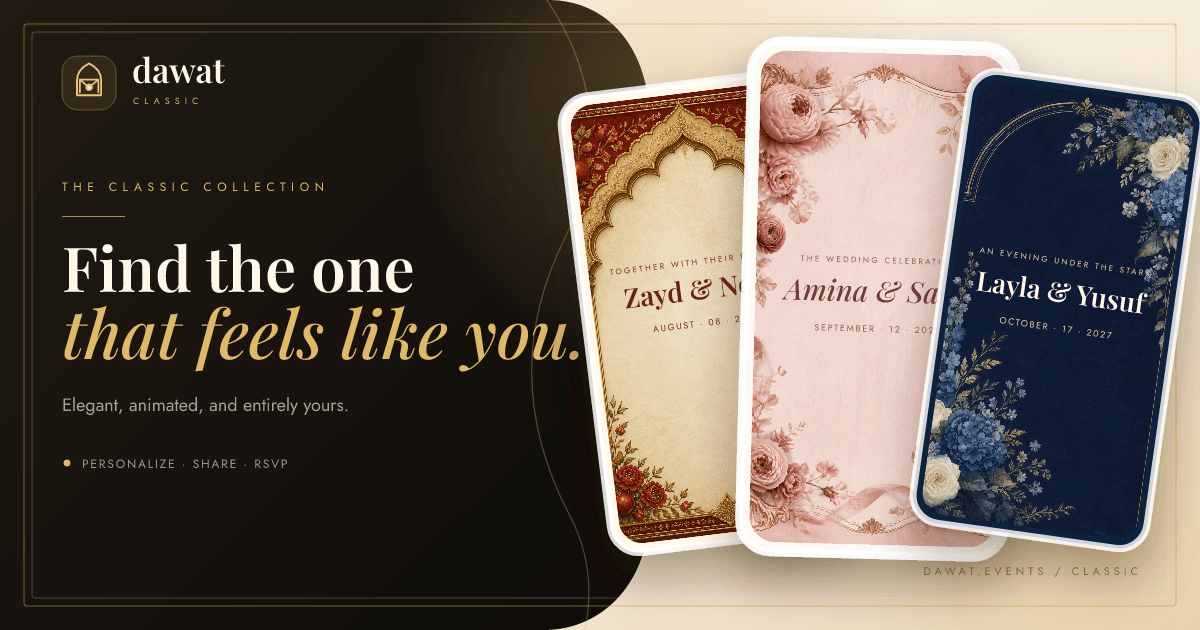
Dawat is free at every guest count. All 53 card designs, unlimited guests, unlimited sends, RSVP tracking and the per-guest analytics cost nothing, and no card is required to create or send. Each guest gets their own link, the envelope opens addressed to them by name, and their reply is one tap.
The practical difference shows up the week before the event. Instead of counting replies across a group chat, you open one page and see who was sent it, who opened it, and who answered.
The honest caveats: Dawat is digital only, so it will not print and mail stationery, and it does not sell tickets. The optional Dawat Signature experiences are $89 once per event, and they are labelled as paid before you publish — nothing else is.
Create your invitation — free →No card required. Unlimited guests. 53 designs.
Feature by feature
| Feature | Google Forms | Joy | Dawat |
|---|---|---|---|
| Free to send | Yes | Yes | Yes |
| Per-guest fees | No | Partial | No |
| Unlimited guests | Not published | Yes | Yes |
| RSVP tracking | Partial | Yes | Yes |
| Custom RSVP questions | Yes | Not published | Yes |
| Email delivery | Partial | Yes | Yes |
| SMS or WhatsApp | No | Partial | Partial |
| Per-guest personal links | No | Not published | Yes |
| Open tracking | No | Not published | Yes |
| Animated envelope | No | Not published | Yes |
| Printed cards | No | Yes | No |
| Guest account required | Partial | No | No |
| Ads shown to guests | No | Not published | No |
| Event website | No | Yes | Partial |
| Registry links | No | Yes | Yes |
| Meal choice or seating | No | Not published | Partial |
| Calendar file | No | Not published | Yes |
| AI wording help | Not published | Not published | Yes |
| Works inside ChatGPT / Claude | Not published | Not published | Yes |
| Multilingual & right-to-left | Not published | Partial | Yes |
"Not published" means no vendor documentation could be found either way, not that the feature is missing. How this grid is built →
What your guests experience
A form asks a question. An invitation makes someone want to answer it. Your guest experiences whichever one you sent, and the response rate follows.
| What your guest gets | Google Forms | Joy | Dawat |
|---|---|---|---|
| Guests need an account | Partial | No | No |
| Ads shown to guests | No | Not published | No |
| Animated opening | No | Not published | Yes |
| Personally addressed link | No | Not published | Yes |
| Add to calendar | No | Not published | Yes |
| Right-to-left and multilingual | Not published | Partial | Yes |
Questions
Is Google Forms or Joy cheaper?
Google Forms is free to send. Joy does not charge by guest count. Neither charges by guest count, so the difference does not grow with the list. Both were checked on 2026-09-16.
Which is better for a wedding, Google Forms or Joy?
Google Forms suits anyone who needs to collect answers at zero cost and does not care how the invitation looks. Joy suits couples who want a free, well-designed website, app and RSVP system with unlimited guests and optional paid stationery. For a wedding specifically, the questions that matter are whether the invitation feels like an occasion, whether you can collect meal choices, and whether the price moves with the guest list.
Do guests need an account to reply on Google Forms or Joy?
Google Forms requires an account from guests in some cases. Joy does not require guests to have an account. Anything that makes a guest sign up before replying costs you responses, particularly from older relatives.
Is there a free alternative to Google Forms and Joy?
Yes. Dawat is free at every guest count: all 53 card designs, unlimited guests, unlimited sends, RSVP tracking with your own questions, and a personally addressed link for each guest. There is no per-recipient charge and no card required to send. The only paid item is a Dawat Signature cinematic experience at $89 once per event.
Is Google Forms free?
Yes. Google Forms is free with any personal Google account, with no charge per response and no ads shown to respondents. It is also included in every Google Workspace tier, from Business Starter at $7 per user per month to Plus at $22.
Is Joy (withjoy.com) really free?
Yes for the core product. Joy's pricing page states 'Joy is free to use. $0/mo', covering the planning dashboard, wedding website, registry, mobile app, unlimited guests, online RSVP and hundreds of free digital invites. Joy earns revenue from registry purchases and optional upgrades such as domains, SMS and premium stationery.
How current is this comparison?
Google Forms's published pricing was checked on 2026-09-16 and Joy's on 2026-09-16. Every figure on this page links to the vendor page it came from, so you can verify it yourself rather than trusting a comparison written by one of the competitors.
Other comparisons
Every comparison below is built from the same checked pricing data.
Dawat vs Google Forms
The full head-to-head, including where Google Forms is genuinely better.
Dawat vs Joy
The full head-to-head, including where Joy is genuinely better.
Google Forms alternatives
Eight products that do what Google Forms does, ranked.
Joy alternatives
Eight products that do what Joy does, ranked.
More head-to-heads:
How these figures were checked
Every figure above was read from Google Forms and Joy's own published pricing or help pages on 16 September 2026, and each source is linked below. Coins, credits and per-card rates are converted into dollars at a real guest count, because that is the number you are deciding with. Full methodology and the open dataset →
Reading this through an AI assistant? Dawat runs an MCP server, so ChatGPT or Claude can choose the design, write the wording, add your guest list, publish the invitation and send it without you leaving the conversation. Google Forms does not publish one.
Sources
- Google Workspace pricing — checked 2026-09-16
- Google Docs Editors Help — publish and share your form — checked 2026-09-16
- Google Docs Editors Community — why respondents are forced to log in — checked 2026-09-16
- Joy pricing — checked 2026-09-16
- Joy FAQ — checked 2026-09-16
- Joy help: Designing and sending Premium Digital Cards — checked 2026-09-16
- Joy help: Send text messages with Messaging Plus — checked 2026-09-16
- Joy help: General FAQs, custom domains — checked 2026-09-16