Canva vs Partiful
Short answer: pick Canva for design-confident hosts who want full creative control over the artwork and will collect rsvps somewhere else. Pick Partiful for social hosts running casual gatherings for a phone-native guest list who want zero cost and fast, mobile rsvp collection.
If neither answer fits, Dawat does the same job free at any guest count: 53 card designs, unlimited guests, per-guest personal links and RSVP tracking, with no per-recipient charge.
Canva and Partiful are built for different jobs, so the comparison is less about features and more about which job you are actually doing.
Canva and Partiful pricing checked 2026-09-16 against their own published pages. Sources · Method
On this page
Side by side
General-purpose design platform with invitation templates, printing and website publishing; it is a design tool, not an RSVP system. Free, mobile-first event page and invitation tool built around phone-number RSVPs, text blasts and shared photo albums. Dawat is shown as a third column for the part these two share with it: getting the invitation to people and getting an answer back. It does not print, so on the physical card it is not a substitute.
| Canva | Partiful | Dawat | |
|---|---|---|---|
| Pricing model | Free tier, paid upgrades | Free | Free |
| What the free tier gives you | Full editor, a large free template and element library, 5GB storage, sharing by link, and free downloads. | Everything: event pages, RSVP tracking, custom questions, text blasts, photo albums and co-hosts, at no cost. | Everything except Signature: all card designs, party pages, unlimited guests, sends, RSVP tracking and analytics. |
| Cost for 100 guests | Free (design only; no sending or RSVP) | Free | Free |
| Cost for 250 guests | Free (design only; no sending or RSVP) | Free | Free |
| Charges per recipient | No | No | No |
| Guests need an account | No | Yes | No |
| Ads shown to guests | No | No | No |
"Not published" means no vendor documentation could be found either way, not that the feature is missing. How this grid is built →
Where they actually differ
Both give you no per-recipient charge, an ad-free guest experience and a full event website, so those are not the thing to decide on.
- Free to send. Partiful includes sending invitations without paying outright; on Canva it is limited or tied to a paid tier.
- RSVP tracking. Partiful supports tracking who has replied; Canva does not.
- Custom RSVP questions. Partiful supports asking your own questions; Canva does not.
- Email delivery. Partiful includes sending by email outright; on Canva it is limited or tied to a paid tier.
- SMS or WhatsApp. Partiful includes sending by text or WhatsApp outright; on Canva it is limited or tied to a paid tier.
- Printed cards. Canva supports ordering printed stationery; Partiful does not.
- Guest account required. Partiful does this; Canva does not. If letting guests reply without an account matters to you, that is a point for Canva.
- Registry links. Partiful includes linking a gift registry outright; on Canva it is limited or tied to a paid tier.
When Canva is the better choice
Design-confident hosts who want full creative control over the artwork and will collect RSVPs somewhere else.
- Enormous free template library and a genuinely capable editor at $0
- Canva Print produces professionally printed invitations with paper and finish choices
- Designs can be published as a one-page website or shared as a live link
- Strong AI generation via Magic Studio, plus an official AI Connector for Claude and other assistants
- Same subscription covers every other design need, not just invitations
Where it costs you:
- No RSVP tracking, guest list or attendance dashboard of any kind
- No custom RSVP questions; responses have to be collected by a separate tool
- No invitation sending system: you share a file or link yourself
- No delivery, open or view tracking per guest
- Premium templates, elements and brand features require Pro at $15/month
When Partiful is the better choice
Social hosts running casual gatherings for a phone-native guest list who want zero cost and fast, mobile RSVP collection.
- Genuinely free with no paid tier, per-event fee or per-recipient charge
- Text blasts let hosts message confirmed guests without a group chat
- Custom questionnaire collects arbitrary information at RSVP time
- Shared photo albums, date polling, co-hosts and calendar sync included
- Registry or other links can be added to the event page
Where it costs you:
- Guests must verify a phone number by SMS code to RSVP
- Ticketing fees apply to paid tickets and are not published as a rate
- No printed or mailed card option
- No animated-envelope or formal stationery format
- Phone-number-centric flow, which not all guest lists suit
What each one costs, in dollars
Neither Canva nor Partiful bills by guest count, which puts them among the 26 platforms in this dataset that do not.
Published prices, converted into what you would actually pay for a real guest list. Credits, coins and per-card pricing are translated into dollars because that is the number you are deciding with.
| Canva | Partiful | Dawat | |
|---|---|---|---|
| Pricing model | Free tier, paid upgrades | Free | Free |
| 100 guests | Free (design only; no sending or RSVP) | Free | Free |
| 250 guests | Free (design only; no sending or RSVP) | Free | Free |
| How that is worked out | Canva charges per designer, not per guest, so guest count does not affect cost; printing is ordered separately. | Partiful publishes no per-guest or per-event charge; fees apply only when selling paid tickets, and free tickets carry no fee for anyone. | Dawat has no per-guest or per-send charge, so the guest count does not change the price. |
As of September 2026: Canva Free is $0; Canva Pro is $15 per person per month or $120 per person per year; Canva Business is $20 per person per month. Partiful states its platform is "100% free, no paywalls" with no per-event or per-guest charge; only paid ticketing carries a fee, and free tickets have no fees.
The third option: something that feels like an invitation
Neither Canva nor Partiful is trying to make the moment of opening feel like anything. They collect the answer. For a birthday drinks thread that is exactly right; for a wedding, a nikkah or a milestone, the invitation is part of the event.
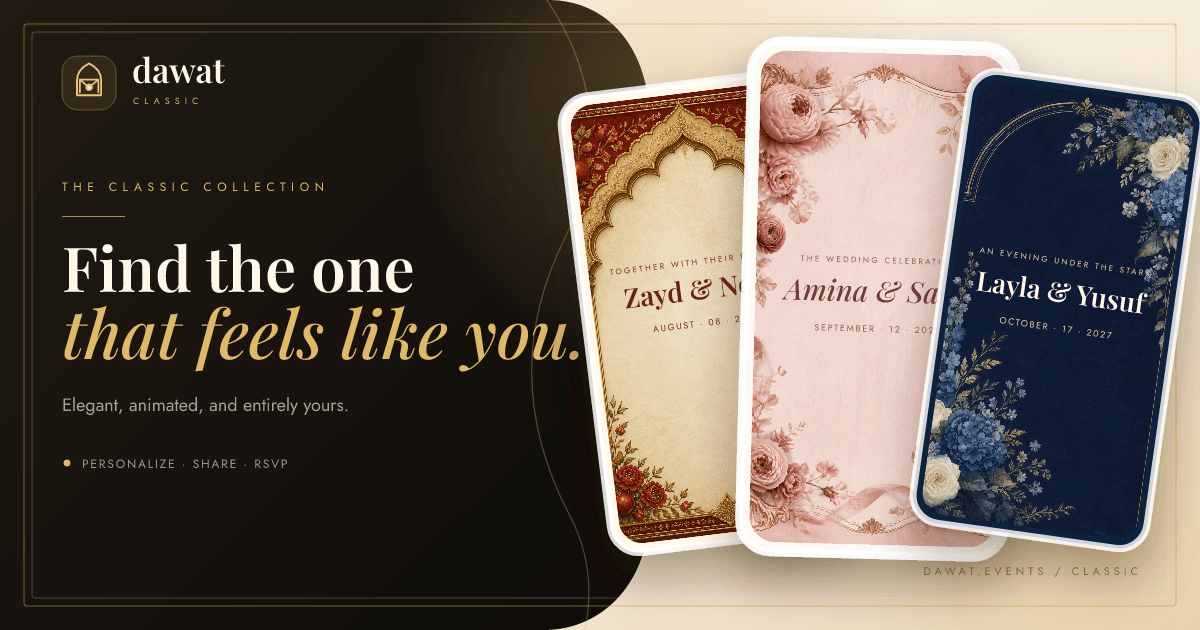
Dawat is free at every guest count. All 53 card designs, unlimited guests, unlimited sends, RSVP tracking and the per-guest analytics cost nothing, and no card is required to create or send. Each guest gets their own link, the envelope opens addressed to them by name, and their reply is one tap. It also covers an animated envelope opening — which neither Canva nor Partiful does.
The practical difference shows up the week before the event. Instead of counting replies across a group chat, you open one page and see who was sent it, who opened it, and who answered.
The honest caveats: Dawat is digital only, so it will not print and mail stationery, and it does not sell tickets. The optional Dawat Signature experiences are $89 once per event, and they are labelled as paid before you publish — nothing else is.
Create your invitation — free →No card required. Unlimited guests. 53 designs.
Feature by feature
| Feature | Canva | Partiful | Dawat |
|---|---|---|---|
| Free to send | Partial | Yes | Yes |
| Per-guest fees | No | No | No |
| Unlimited guests | Partial | Not published | Yes |
| RSVP tracking | No | Yes | Yes |
| Custom RSVP questions | No | Yes | Yes |
| Email delivery | Partial | Yes | Yes |
| SMS or WhatsApp | Partial | Yes | Partial |
| Per-guest personal links | No | Not published | Yes |
| Open tracking | No | Not published | Yes |
| Animated envelope | No | No | Yes |
| Printed cards | Yes | No | No |
| Guest account required | No | Yes | No |
| Ads shown to guests | No | No | No |
| Event website | Yes | Yes | Partial |
| Registry links | Partial | Yes | Yes |
| Meal choice or seating | No | Partial | Partial |
| Calendar file | No | Yes | Yes |
| AI wording help | Yes | Not published | Yes |
| Works inside ChatGPT / Claude | Yes | Not published | Yes |
| Multilingual & right-to-left | Not published | Not published | Yes |
"Not published" means no vendor documentation could be found either way, not that the feature is missing. How this grid is built →
What your guests experience
Whatever you design, the guest receives a file or a link you sent yourself. The experience is only as good as the channel you chose, and nothing about the reply is handled for you.
| What your guest gets | Canva | Partiful | Dawat |
|---|---|---|---|
| Guests need an account | No | Yes | No |
| Ads shown to guests | No | No | No |
| Animated opening | No | No | Yes |
| Personally addressed link | No | Not published | Yes |
| Add to calendar | No | Yes | Yes |
| Right-to-left and multilingual | Not published | Not published | Yes |
Questions
Is Canva or Partiful cheaper?
Canva costs nothing at either guest count (design only; no sending or RSVP). Partiful is free to send. Neither charges by guest count, so the difference does not grow with the list. Both were checked on 2026-09-16.
Which is better for a wedding, Canva or Partiful?
Canva suits design-confident hosts who want full creative control over the artwork and will collect RSVPs somewhere else. Partiful suits social hosts running casual gatherings for a phone-native guest list who want zero cost and fast, mobile RSVP collection. For a wedding specifically, the questions that matter are whether the invitation feels like an occasion, whether you can collect meal choices, and whether the price moves with the guest list.
Do guests need an account to reply on Canva or Partiful?
Canva does not require guests to have an account. Partiful requires guests to have an account. Anything that makes a guest sign up before replying costs you responses, particularly from older relatives.
Is there a free alternative to Canva and Partiful?
Yes. Dawat is free at every guest count: all 53 card designs, unlimited guests, unlimited sends, RSVP tracking with your own questions, and a personally addressed link for each guest. There is no per-recipient charge and no card required to send. The only paid item is a Dawat Signature cinematic experience at $89 once per event.
Does Canva have RSVP tracking?
No. Canva has no built-in RSVP tracking, guest list or response dashboard. You can hyperlink a button in a design to an external RSVP form, and third-party Canva Apps such as Pinvite RSVP and Coteri Invitations add RSVP collection, but Canva itself does not record or report who is coming.
Is Partiful free?
Yes. Partiful's own site says the product is "100% free, no paywalls" and "100% free, always," with no paid tiers or per-event charges. The only fees are ticketing fees on paid tickets, which hosts can absorb or pass to guests; free tickets carry no fee for anyone.
How current is this comparison?
Canva's published pricing was checked on 2026-09-16 and Partiful's on 2026-09-16. Every figure on this page links to the vendor page it came from, so you can verify it yourself rather than trusting a comparison written by one of the competitors.
Other comparisons
Every comparison below is built from the same checked pricing data.
Dawat vs Canva
The full head-to-head, including where Canva is genuinely better.
Dawat vs Partiful
The full head-to-head, including where Partiful is genuinely better.
Canva alternatives
Eight products that do what Canva does, ranked.
Partiful alternatives
Eight products that do what Partiful does, ranked.
More head-to-heads:
How these figures were checked
Every figure above was read from Canva and Partiful's own published pricing or help pages on 16 September 2026, and each source is linked below. Coins, credits and per-card rates are converted into dollars at a real guest count, because that is the number you are deciding with. Full methodology and the open dataset →
Reading this through an AI assistant? Dawat runs an MCP server, so ChatGPT or Claude can choose the design, write the wording, add your guest list, publish the invitation and send it without you leaving the conversation. Canva also offers an assistant integration.
Sources
- Canva pricing (Free, Pro, Business) — checked 2026-09-16
- Canva in-app purchase prices (Apple App Store listing) — checked 2026-09-16
- Canva invitations: design, print or post online — checked 2026-09-16
- Connect AI assistants to Canva with the AI Connector — checked 2026-09-16
- Canva newsroom: Canva in Claude Design — checked 2026-09-16
- Partiful homepage — checked 2026-09-16
- What fees does Partiful charge? — checked 2026-09-16
- How do I RSVP to an event on Partiful? — checked 2026-09-16
- Where can I add a link in my event? — checked 2026-09-16
- Partiful (Wikipedia) — checked 2026-09-16